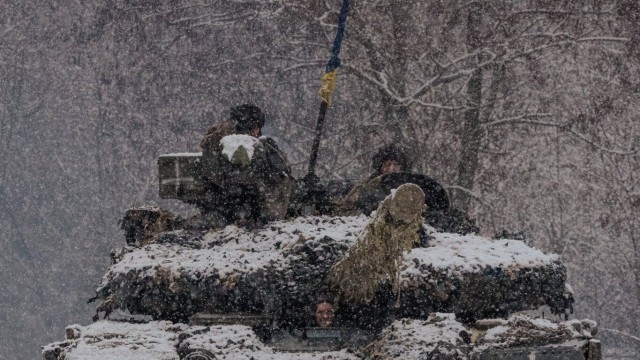
It is the early morning of February 24th, 2022. Just minutes after the president of Russia, Vladimir Putin declares his “Special Military Operation” or simply full-scale invasion in Ukraine, the Russian 3M-54 Caliber Cruise Missile is on the way toward its target. First, it seems like it will strike the capital of Ukraine, Kyiv, like many other missiles today. However, its real target is the military base 3018 of the National Guard of Ukraine, just 10 kilometers away from the city. Around 6 am, the missile explodes on the empty exercise ground in front of the barracks. A couple of minutes later, another one hits near the local residential buildings. This is the first attack on the small town, which will become known for one of the most significant and fierce battles of the first days of the full-scale Russian invasion. This town is called Hostomel.
It’s the early evening of April 13th, 2022. Just 120 kilometers from the shore, Ukrainian land radar detects some large vessel. After carefully verifying and analyzing data, Ukrainians come to a surprising conclusion. On the 49th day of the Full-Scale Russian Invasion, they finally tracked down something big. The target is correctly identified as the warship Moskva, the flagship of the Russian Navy's Black Sea Fleet, which performs its duties as a part of invading force.
It’s the early morning of October 8th, 2022. At approximately 6 am, the policeman checks the truck that travels from Russia to the annexed part of Ukraine. After the brief talk with the driver, the policeman takes a look inside. Seeing only some industrial film reels policeman decides to come back to more important business and lets the truck continue its journey to the Crimean peninsula. The only way to get there is via the Kerch Strait Bridge, which connects the Russian mainland with the territory of Ukraine, occupied by Russia in 2014. The policeman, however, did not realize that the truck that he had just inspected will never get to the end of Crimean Bridge.
It is the early morning of February 24, 2022. Russian forces in the Belgorod region that for months were amassing on the Ukrainian border under the cover of military exercises are now ready to fulfill their true mission. Three Russian Armies, 1st Guards Tank, 20s Guards Combined Arms, and 6th Combined Arms plan to launch a land attack on one of the key Ukrainian cities. In total, they have around 20000 men with hundreds of tanks and armored vehicles, backed up with rocket and conventional artillery. Their target is the second largest city in Ukraine, Kharkiv. Major industrial, economic, and cultural center with a pre-war population of 1.5 million people. After the capital Kyiv, it has the second-largest number of military-related enterprises such as tank and armored vehicle factories as well as suppliers of a variety of military aviation components.
t’s June 23rd, 2023. The social media pages of Private Military Company Wagner start sharing a video about what they called a rocket and artillery strike on their camps. However, the PMC, which was involved in fighting with Ukraine on the Russian side for almost the whole duration of the conflict, adds a shocking detail. The strike was allegedly authorized by the Russian Ministry of Defense. Wagner mercenaries are currently recovering in their training camps in the occupied Ukrainian Donbas Region after the devastating battle for Bakhmut. The camps where most of the mercenaries are located were out of the reach of the Ukrainian military, so according to the Wagner chief, Yevgeniy Prigozhin, the Russian Ministry of Defense deliberately started destroying its now former allies.
It’s the early morning of February 24th, 2022. At 4:30 am, two Russian tankers in the Sea of Azov, start moving directly to the city of Mariupol by the shortest path from Yeysk. This atypical behavior is seen on the radar screens in the Coastal Defense Headquarters at Mariupol Airport. There, the officers from multiple units responsible for the Ukrainian coastline come to the conclusion that the Russian Invasion of Ukraine has begun. The orders are given to start mining the waters near the Mariupol seaport. In a few hours, they are proven right as the city is attacked by naval artillery of Russian ships that apparently use tankers as decoys. Simultaneously, Russian cruise missiles, attack aviation, and land artillery start pounding the Ukrainian defenses in the east, giving the official start to the battles for Mariupol. Invaders also specifically target the Coastal Defense Headquarters but failed to inflict significant damage. Still, the operations of the center are halted as most of
t’s the early morning of August 29th, 2022. In the occupied city of Kherson, which is currently under the control of Russian troops, a barrage of GMLRS guided missiles strikes the command post of the Russian military. The ammunition and vehicle depots in Beryslav, located on the territory of the machine-building plant, are under a similar strike, as well as military objects in Havrylivka and Lvove, which were most likely the places of troops’ concentrations. Ukrainian missiles also pound the Kakhovka Dam bridge. Such strikes that aimed to isolate Russians on the right bank of the Dnipro River were quite common during July and August and significantly degraded the main Russian supply lines through Antonivka car and train bridges. However, the strikes on August 29th are abnormally numerous, because, on this day, Ukraine begins its major counteroffensive to retake the city of Kherson and sweep the only Russian lodgement area on the right bank of the Dnipro River.
It’s early morning of September 6th, 2022. As all the eyes of the world are focused on the counteroffensive that began in the Kherson region a week ago, Ukrainians intensify their artillery strikes in the Kharkiv region. Here, Russians expected a series of small-scale tactical offensives from Ukrainians, but they severely miscalculated the forces that their adversary gathered. Maintaining their primary focus on the Kherson region, Russian higher military command made a strategic blunder. And Ukrainians are about to use it to inflict one of the most humiliating and significant defeats on their enemy since the beginning of the Russian invasion of Ukraine.
It’s an early morning of June 7th, 2023. After Ukrainian artillery intensifies strikes on dug-in Russian forces, the offensive, announced a long time ago enters its crucial phase. Ukrainians, jump into their newly acquired Leopard 2A6 tanks, M2 Bradleys, and other armored mine-clearing and mobility vehicles to form columns and cut through Russian minefields and defenses. Understanding all the responsibility and complexity of the task, the soldiers of the recently formed 47th Mechanized Brigade are optimistic about their chances of completing the mission. However, heading toward the village of Robotyne they are about to face immense resistance, not even closely resembled during their months of training in Western countries.
It’s a quiet night of October 17th, 2023. A sudden disruption shatters the silence as Ukrainians, at 3 am, launch missiles from HIMARS and M270 systems situated in eastern Ukraine. This time, they employ secretly obtained long-range ATACMS Block 1A ballistic missiles from the U.S. Within minutes, six missiles are launched from one site, followed by three from another.
It’s the afternoon of August 9th, 2023. Russian Mi-8, with a crew of three, pilot Maxim Kuzminov, flight engineer Nikita Kiryanov, and navigator Khushbakht Tursunov take off from the "Kursk" airfield. At 4:30 pm, their cargo mission begins with the aim to quickly deliver a few fighter jet parts from one Russian Air Force base to another. However, two of the crew members still are unaware that their routine flight is part of a much bigger Ukrainian operation that very few countries ever attempted to execute on their adversary.
It’s an early morning of July 17th, 2023. At approximately 3:00 am, the sudden explosion rocks the railroad and road strands of the Crimean Bridge. The crucial supply route that connects the continental part of Russia with the occupied in 2014 Crimean Peninsula provides a convenient flow of supplies to the southern grouping of Russian forces that is currently in the midst of repelling the Ukrainian 2023 Counteroffensive. Therefore, the bridge is one of the priority targets for the Ukrainian military command.
If on land and in the air, Russia went to war with Ukraine having a strong quantitative advantage in numbers of every weapon system available, on the sea, such advantage was the most prominent. Initial Russian plans were to use their Black Sea fleet that could conveniently operate in both, the Black Sea and the Sea of Azov from multiple naval bases in Crimea in a supporting role for land forces. This is because the Ukrainian fleet was not seen as even a minor threat to any of the Russian ships. The idea included enforcing a naval blockade of both military and merchant Ukrainian vessels just for enough time for land forces to capture the main Ukrainian ports in Odesa and Mykolaiv together with intact assets. Focusing on the first two years of the war, we want to tell how exactly Ukraine managed to completely turn the tables on the sea, achieving the unthinkable. Without much of its conventional fleet, eventually enforcing its own naval blockade of Russian military ships across the Black
In the late Spring of 2022, Russian forces who retreated from northern Ukraine after failure to take the capital, Kyiv, shift their focus to the eastern part of the country, Donbas. Here, since 2014, parts of Ukrainian Donetsk and Luhansk regions have been occupied by Russian proxy states, LPR and DPR. On the border with them, Ukraine has some of its most capable troops, well dug in and reinforced prior to the invasion, as limited advance in Donbas was seen as one of the alternatives to what actually happened, full-scale war. After the redeployment of troops which failed to take Kyiv to eastern Ukraine, new Russia's strategy is to encircle Ukrainian forces on the east, destroying them once and for all, and annex the entire Donetsk and Luhansk regions which will open the road to further conquest of central Ukraine. Even more ambitious plans circulate with a commander of Russia's Central Military District, Rustam Minnekayev, declaring that the aim of the "second phase" of the so-called S
During the summer of 2022, Russian forces who retreated from northern Ukraine in the spring, shift their focus to the Donbas region. The war-torn part of Ukraine bears not just symbolic meaning due to Russia’s claims that they are saving the local population which they dragged into the war in the first place, but also is a promising direction of advance. The concentration of Ukrainian forces in this region, bolstered by reinforcements deployed prior to the invasion, presents a formidable obstacle to Russian advances from the territories of the DPR and LPR proxies. Since April 20th, 2022, Russians have initiated a new strategic offensive, usually referred to as the “Battle for Donbas” aiming to swiftly encircle and eliminate the main Ukrainian forces to open the road to further conquest of central Ukraine. The deteriorating situation to the north, in the Luhansk region, however, together with the Russian local breakthrough in Popasna, forced Ukrainians to retreat from one of the key cit
It’s a freezing night on January 24th, 2023. The desolate streets of the southeastern Ukrainian town, echo with silence, as destroyed apartment complexes are mostly uninhabited at this point. Nevertheless, underneath the streets, the basements are hives of activity. The operators of Ukrianain night-vision drones see in real-time how hundreds of Russian armored vehicles pack up into the neighboring town of Mykilske. For a few hours after that, there is no movement, no artillery or air strikes. Only silence, before the storm, as the Russian Armed Forces are about to launch their long-awaited winter offensive. Their objective is the key town of Vuhledar.
The city of Avdiivka in eastern Ukraine always had a little more war history than the other nearby towns. Without exaggeration, the battles of various intensities raged around it for 10 years. Located in the heart of the Donetsk Region to the northwest of Donetsk itself, it became a frontline city not in 2022 or 2023 with the full-scale invasion, but in 2014, when Russia just started its proxy war against Ukraine, often called War in Donbas. Despite the 4 months long occupation in 2014, subsequent liberation by the Ukrainian Armed Forces, and numerous attacks in 2017, Avdiivka remained under firm Ukrainian control, becoming an important outpost just on the outskirts of occupied Donetsk.
In early February 2023, officials of Russia's Bryansk region proudly claimed that they had reinforced the border with Ukraine in the course of the first year of the war. The governor, Alexander Bogomaz, even met with officers from the so-called “separate grouping of forces for border protection” and boasted about how the military commanders were praising the formidable fortifications. Little did he know, that just three weeks later, the border will be inspected again by his compatriots. The only problem is that it will be inspected and then crossed not from the Russian side but from a Ukrainian one.
Right after the last Russian troops retreated from the right bank of the Dnipro River as a result of the Ukrainian Kherson Counteroffensive in November 2022, the frontline established on the river generally lost its high priority. After all, Dnipro, even at its narrowest point near the recently liberated Kherson, has a width of around 300m. The last pre-war crossing in this area, the damaged Antonivka bridge, was blown up by Russians upon retreat on November 10th. Another bridge on the Kakhovka Dam was also destroyed by Russians after it sustained damage from Ukrainian HIMARS during a counteroffensive. This prevents both sides from crossing the river in force, as any significant concentration of troops on the river bank or pontoon bridges will be quickly spotted by omnipresent reconnaissance drones and devastated by artillery. Many thought that this area would never become a focal point of the war again. However, as always, deprioritized areas of the frontline tend to become ideal plac
Unlike in our past projects, today, there will be no maps, no unit signs, and no arrows. Today we have a unique opportunity to dive deep into a firsthand account of modern warfare, in particular, the Ukrainian one. Without further ado, I introduce Roman, a soldier who has worn many hats—from sniper and anti-tank weapon operator to stormtrooper—fighting in some of the most intense battles since 2015, including Kyiv and Bakhmut.
It’s the early morning of February 24th, 2022. In the border village of Dniprovske, Ukrainian 105th Border Detachment soldiers sleep in their barracks, unaware of the approaching storm. A missile from a drone strikes without warning, wounding six and marking the start of Russia's full-scale invasion. Despite the chaos, the border guards act swiftly, blowing up the mined bridge across the Dnipro River to slow the enemy's advance. Along the Chernihiv Region border, similar scenes unfold— Russian artillery, drones, and aviation hammer all the Ukrainian border checkpoints from both Russia and Belarus. And this is how the battle for Nothern Ukraine and its key fortress, Chernihiv, begins.
It’s the early morning of February 24th, 2022. The cold silence of the Ukrainian Sumy region is broken by the sound of hundreds of engines. The endless columns of Russian vehicles begin their seemingly unstoppable push across the Ukrainian border, following key highways. Their goal is not a diversion or capture of small villages but a strike right into the heart of Ukriane, its capital, Kyiv. And the most elite part of the Russian invasion force is planning to reach it right through the Sumy region.
A British volunteer’s journey from offering aid to fighting on the front lines as a Ukrainian Marine. Why did he make this life-changing decision? What challenges did he face? In this exclusive interview, he shares his experiences, motivations, and the reality of war.
When it comes to reviews of modern military equipment, people’s attention is often drawn to the more obvious — tanks, fighter jets, drones, or warships. While these indeed play crucial roles in contemporary warfare, today we want to spotlight something less flashy but perhaps not less significant. This piece of engineering has become the backbone of the Russian military, especially as strategic missteps have forced it into a war of attrition. Prepare to meet the legend: the UAZ-452, or simply, “ Loaf”.
In this video, we explore the major events and turning points of the 2022 Ukraine-Russia war. From early Russian advancements to Ukrainian counterattacks, we analyze the key battles, strategic decisions, and shifts in momentum that defined the conflict throughout the year. We look at the strategic importance of southern Ukraine, including critical cities and infrastructure that both sides fought to control. We examine the role of local Ukrainian defense forces and partisans, who played a crucial role in slowing down Russian advances and disrupting supply lines. The video also highlights how both Ukrainian and Russian military strategies evolved in response to changing battlefield conditions. Join us as we break down the battles, military tactics, and the broader geopolitical implications of the ongoing conflict between Ukraine and Russia in 2022.
In Part 1 of our dilogy about the early days of the Russian invasion of Southern Ukraine, we discussed how, in the first week of the heavy combat, Russians had managed to break through initial Ukrainian lines and capture the first regional center, Kherson. However, delaying actions of Ukrainian armed forces during the retreat allowed the formation of a new line of defense anchored on cities like Mykolaiv, Bashtanka, and Voznesensk, according to the plan of Major General Dmytro Marchenko, head of Mykolaiv defense. Moreover, in the Battle of Voznesensk, Ukrainians routed Russians, inflicting heavy losses on the adversary and putting an abrupt end to the unrestricted enemy advance. This victory is the first sign that Ukrainians start regaining initiative despite the initial catastrophic defeats that led to quite a complex situation on the Southern Front.
In 2023, the northern part of the Kharkiv region was one of the few Ukrainian eastern parts that saw almost no active combat. After the Russians retreated in Fall 2022 as a result of the Ukrainian Kharkiv Counteroffensive, the topic of one of our past videos, both sides used the northern border mostly to keep the troops rotated out of active combat for replenishment. However, the Russian desire to continue advancing in the most reinforced part of Ukraine, Donbas, in 2024 transformed into a more ambitious idea. To launch an additional attack in a place other than the area of the most recent success, the Donetsk region, for the sake of diversion. This place is the northern part of the Kharkiv region.
It’s the early evening in Russia’s Irkutsk region on June 1st, 2025. The driver of one of the container trucks receives a phone call—the cargo owners ask him to pull over at a nearby gas station. The driver follows the instructions precisely. But as soon as he stops, he is deafened by a loud noise. Surprised, he sees how the container's roof falls near the truck, and a second later, a distinct buzzing fills the air. The Ukrainian Spider Web operation has just begun.
In 2024, Ukraine opened a new front inside Russia’s Kursk region — pushing the war beyond the border. This series follows the unfolding offensive, its gains, tactics, real goals, and the shifting frontlines that could reshape the conflict.
The Kursk Offensive of 2024 stands out as one of the most unexpected and daring moves of the entire Russo-Ukrainian War. After months of defensive operations, Ukraine launched a cross-border offensive into Russia’s Kursk region, pushing deep into enemy territory, capturing dozens of settlements, and securing a significant stretch of land. In a matter of days, Ukrainian forces advanced approximately 1,000 square kilometers inside Russian territory — a figure that eclipsed Russia’s gains in both the Kharkiv sector and Donbas during the same period. This operation demonstrated that rapid maneuver warfare, once thought obsolete in the modern drone-dominated battlefield, was still possible with the right combination of lessons learned, operational secrecy, logistics, demining, and carefully chosen axes of advance. In hindsight, the Kursk Offensive delivered more than just territorial gains. It boosted Ukrainian morale, highlighted Russia’s defensive weaknesses, and helped accelerate inter
In Part 2 of our breakdown of the Ukrainian Kursk offensive, we explore how the battle shifted once Russia regrouped and launched counterattacks. After Ukraine’s initial breakthrough and capture of a large swath of territory, Russian forces poured reinforcements into the region, determined to push the Ukrainians back regardless of losses. Fierce clashes unfolded around Korenevo, Snagost, and Liubimovka, where Russian assaults cost them huge numbers of vehicles and troops. Ukraine responded with fresh reinforcements, including modern Western armor, slowing down Russian advances but suffering significant equipment losses of its own. The air war also intensified, with both sides relying heavily on drones, guided bombs, and precision strikes to shape the battlefield. By October, Russia had clawed back much of the territory Ukraine had captured, but only at enormous cost. At the same time, Ukraine succeeded in forcing Moscow to commit a large portion of its elite airborne forces to Kursk,
In Part 3 of our Kursk offensive series, we cover December 2024 through January 2025, as the Russian Grouping of Forces “North” struggles to recover from heavy losses. To reinforce depleted units, Russia deploys 12,000 North Korean troops—well-trained but inexperienced in modern combined-arms and drone-dominated warfare. Initial human-wave assaults cause devastating casualties among DPRK forces, while Ukrainians leverage FPV and fiber-optic drones, cluster munitions, and elite assault units to blunt advances and secure key positions. Russian mechanized units continue frontal attacks with limited gains, suffering high losses from mines, drones, and artillery strikes. By late January, the Ukrainian-held salient shrinks to roughly 400 square kilometers, yet remains fortified and resilient, highlighting both the evolving role of drones in modern combat and the strategic stalemate shaping the Kursk region. This phase sets the stage for upcoming maneuvers and counterattacks.
In this final chapter, we will cover the end of the Kursk Incursion and draw the last set of conclusions about the operation. To see the full picture, make sure you have watched the previous parts. By now, the operation has entered its seventh month, with both sides fighting tooth and nail. The Ukrainians, who captured most of the land in the first month of the offensive, are heavily exhausted. Still, the chance to pin down Russian forces and inflict disproportionate losses drives them to hold onto their positions in the Kursk region. The Russians, on the other hand, continue to pour resources into their counteroffensive, desperate to mitigate the deep humiliation of being invaded themselves after years of trying to defeat Ukraine. So far, this struggle has managed to stall the Russian push toward Pokrovsk and has also drawn North Korean troops into combat, where they suffered heavy casualties. Yet, now it’s only a matter of time before the Ukrainians retreat completely from Kursk. The
The Kursk Offensive of 2024 stands out as one of the most unexpected and daring moves of the entire Russo-Ukrainian War. After months of defensive operations, Ukraine launched a cross-border offensive into Russia’s Kursk region, pushing deep into enemy territory, capturing dozens of settlements, and securing a significant stretch of land. In a matter of days, Ukrainian forces advanced approximately 1,000 square kilometers inside Russian territory — a figure that eclipsed Russia’s gains in both the Kharkiv sector and Donbas during the same period. This operation demonstrated that rapid maneuver warfare, once thought obsolete in the modern drone-dominated battlefield, was still possible with the right combination of lessons learned, operational secrecy, logistics, demining, and carefully chosen axes of advance. In hindsight, the Kursk Offensive delivered more than just territorial gains. It boosted Ukrainian morale, highlighted Russia’s defensive weaknesses, and helped accelerate inter
Despite traditionally being the most covert military branch, Special Operations Forces (SOF) often attract disproportionate attention due to their elite status and high-risk missions. Historically, only a few operations—such as Operation Nimrod, Entebbe, and Neptune Spear—were widely known. The War in Ukraine has transformed that narrative, producing dozens of high-profile examples of SOF in action, showcasing Ukraine’s unparalleled experience in modern warfare, diverse SOF structure, and one of the largest Special Operations communities in the world.
One of the most often cited reasons for Russian military missteps in Ukraine is the idea that the Russian Armed Forces, as a whole, are not learning from their mistakes. On the other hand, there are clear indications that Russian forces are adapting, and that these adaptations, though uneven, explain their ability to continue advancing, even if such advances are modest by any metric other than losses taken. In this video, we will highlight the adaptations Russia has undeniably made throughout the war, focusing on the tactical and operational levels and using a consistent structure for every phase.
Unlike the stories we usually tell, today’s one takes place not in the 21st but in the 20th century. This is because its hero lived through a turbulent era for the entire region and, more importantly, left a lasting legacy that remains relevant to modern events. Today, we will uncover the story of Yaroslav Horoshko, the father of Ukraine’s Defence Intelligence Service (HUR) and Special Operations Forces. When most sources highlight negative tendencies within the Ukrainian military, these are often linked to the claim that Ukraine still retains many traits of the Soviet army. And while this is often true, for the new and independent state that Ukraine became in 1991, there was no choice but to rely on the Soviet legacy. To this day, in the form of equipment and knowledge, these remnants remain part of Ukraine’s military, which at the same time strives to adopt NATO doctrines and, in many cases, go further, redefining modern warfare with innovations such as drones. As we covered in our b
Over March 2024, both sides were mostly replenishing and preparing for the next phase of combat on the most active and complex frontline: Donbas. For Ukrainians, preparations were largely centered on stockpiling hundreds of thousands of drones. Russians, meanwhile, began amassing armor and huge numbers of men to replicate the tactic that allowed them to capture Avdiivka. There, initial armored assaults, usually ending in heavy losses, were followed by repeated attacks by small, echeloned infantry groups. The latter simply had to stretch Ukrainian defenders thin and overwhelm drone-crew capacity, allowing infiltration between positions and, from there, further advances. Since this tactic was used along the whole Donbas frontline with similar intensity, predicting where exactly infiltration would pay off was extremely hard. Today, with the benefit of hindsight, we know: it was the town of Ocheretyne.
Iran has built one of the most distinctive drone arsenals in the world, not by focusing on high-end technology but by producing cheap, scalable, and effective UAVs. From early reconnaissance drones developed during the Iran-Iraq War to today’s Shahed-131 and Shahed-136 loitering munitions, Iran has created a layered drone ecosystem that includes ISR platforms, reusable strike drones, experimental stealth UAVs, and long-range one-way attack drones used across multiple conflicts. In this video, we break down the structure, doctrine, and global impact of Iran’s drone program, including its use by proxies and partners from the Middle East to Ukraine. We also examine how mass drone production, export networks, and recent strikes on Iranian facilities could shape the future of this drone ecosystem and its role in modern warfare.
We spent a long time choosing an army that would serve as a strong starting point for a new series about NATO armies. After careful consideration, we decided to begin with Finland, a country that formally became an alliance member only in the spring of 2023, yet had never truly been novice in matters of national defense.
Russia has become one of the most important drone warfare innovators of the war in Ukraine. In this documentary, we examine the full ecosystem of Russian UAVs, from ISR platforms like the Orlan series and ZALA drones, to Lancet loitering munitions, Geran/Shahed long-range strike drones, and larger MALE systems like Orion and Forpost. Rather than focusing on improvised FPVs, this video looks at standardized, factory-produced drones and how Russia uses them in layered reconnaissance and strike networks. We also explore how these systems evolved through combat, how they interact with electronic warfare, and what their rise means for the future of modern conflict.